ABOUT THIS BLOG

"A Faithful Attempt" is designed to showcase a variety of K-12 art lessons, the work of my art students, as well as other art-related topics. Projects shown are my take on other art teacher's lessons, lessons found in books or else designed by myself.
Thanks for visiting!
LAND ACKNOWLEDGEMENT I acknowledge, with deep respect, that I am gathered on Treaty 7 territory. I acknowledge the many First Nations, Métis and Inuit whose footsteps have marked these lands for generations. I respect the histories, languages and cultures of all the Indigenous peoples of Canada, whose presence continues to enrich our community.
Showing posts with label multicultural art. Show all posts

Thursday, June 12, 2025

Indigenous Plains People Painted Buffalo Hides


In Canada, June is designated as National Indigenous History Month, a time to celebrate and recognize the rich history, heritage, and contributions of First Nations, Inuit, and Métis peoples. Additionally, June 21st is recognized as National Indigenous Peoples Day, a specific day to highlight Indigenous cultures and achievements. 

Why do non-Indigenous Canadians need to learn about Indigenous history?

For many Canadians, the history of Indigenous Peoples and Canada was, until recently, unknown. Generations of Canadians have gone through their lives without knowing about residential schools, the historic and ongoing impacts of the Indian Act, the significance of treaties, or the contributions of Indigenous Peoples to the mosaic of Canada. 

Canada is often recognized as a leader in reconciliation efforts with Indigenous peoples, due to its commitment to recognizing Indigenous rights, addressing historical injustices, and engaging in nation-to-nation relationships. While significant progress has been made, the journey towards reconciliation is ongoing and faces ongoing challenges. 

So in art class, my Grade 4-6 students learned about and made their own versions of painted buffalo hides of the Plains Peoples. We looked at photos and watched videos


You can find many buffalo hide templates online. We painted them with brown liquid watercolours first and let dry. Then they sketched on their designs using pencils. Once students finished drawing and colouring their designs using pencil crayons, they cut them out and glued them onto brown construction paper. 


Thursday, July 6, 2023

Russian Matryoshka Doll Drawings


This is a great sub lesson as it uses very simple materials yet keeps the students engaged. It's also a great Global Arts lesson (traditional Russian craft) as well as teaching the art elements of pattern and shape and colour

See my previous post about these HERE.

I grew up having a set of matryoshka dolls which I absolutely adorned and was just this year, gifted a GORGEOUS set by one of my students who is originally from the region. There's something about opening up the set that is so magical and then closing it up and trying to line it all up perfectly is really satisfying.

I found a template online HERE for matryoshka dolls. I believe the original lesson for this (a card) is from HERE. The bodies and faces are separate. I enlarged it onto 11x17" photocopy paper. You could also use cardstock. I did this lesson with a mixed grade class from 4 - 6. I showed them a slideshow of different types of matryoshka dolls and we discussed the characteristics and the history of them. 

Matryoshka dolls, also known as nesting dolls or Russian dolls, are a set of wooden dolls of decreasing size placed one inside another. The name matryoshka, mainly known as "little matron", is a diminutive form of Matryosha (Матрёша), in turn a diminutive of the Russian female first name Matryona.

History

The first Russian nested doll set was carved in 1890 at the Children's Education Workshop by Vasily Zvyozdochkin and designed by Sergey Malyutin, who was a folk crafts painter in the Abramtsevo estate of Savva Mamontov, a Russian industrialist and patron of arts. Mamontov's brother, Anatoly Ivanovich Mamontov (1839–1905), created the Children's Education Workshop to make and sell children's toys. The doll set was painted by Malyutin. Malyutin's doll set consisted of eight dolls—the outermost was a mother in a traditional dress holding a red-combed rooster. The inner dolls were her children, girls and a boy, and the innermost a baby.  Savva Mamontov's wife presented the dolls at the Exposition Universelle in Paris in 1900, where the toy earned a bronze medal. Soon after, matryoshka dolls were being made in several places in Russia and shipped around the world.

Themes

Matryoshka dolls are often designed to follow a particular theme; for instance, peasant girls in traditional dress. Originally, themes were often drawn from tradition or fairy tale characters, in keeping with the craft tradition—but since the late 20th century, they have embraced a larger range, including Russian leaders. Common themes of matryoshkas are floral and relate to nature. 


STEPS

I have some actual examples of the dolls- they were passed around so students could play with them. You can find these at Eastern European import stores or, if you're lucky, thrifting! I always keep an eye out for them and get super excited if I find one as they can be quite expensive when bought brand new. So far I've only found one but it only had one doll inside, so definitely not a complete set.

Then students start sketching out their designs directly on the template. They could do either traditional designs or something more contemporary of their choice. Draw the faces, then cut them out and glue them onto the bodies.
Outline everything in fine tip Sharpie once finished drawing.


Colour in: I give the choice of coloured pencils or markers but I do prefer the look of markers. 


Cut all the pieces out. The bodies are connected on the template because  it's meant to be a folded standing card. But I didn't do that but feel free to do it that way!


Then glue onto construction paper. This helps give a sturdier background.


And bubble cut around that.


Some finished artworks: Grades 4,5 and 6
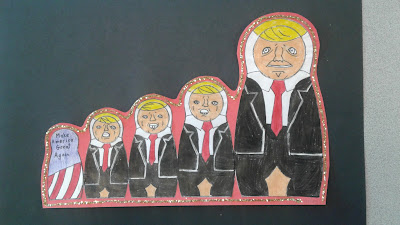


this was a political parody


Thursday, December 8, 2022

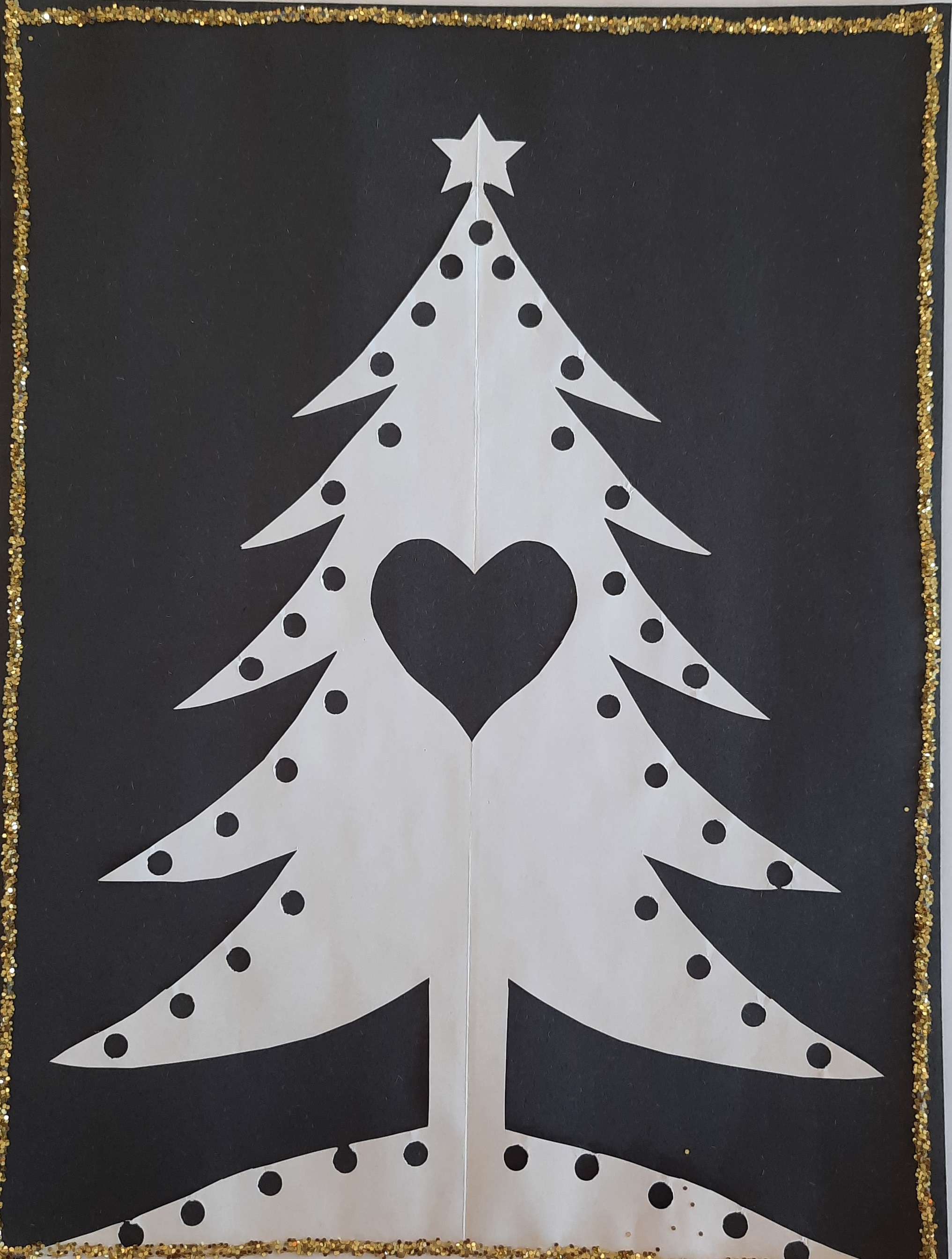
Polish Wycinanki Evergreen Tree Paper Cuts-outs


This is a great lesson for the last couple of weeks before school lets out for Christmas vacation. It involves only paper, a hole punch, scissor and glue sticks. Very little prep but yet still results in gorgeous artwork- my kind of lesson for right before the holidays when we're all tired!

I showed my Grade 5 students some examples of Polish wycinanki. These folk paper cutouts were used in the 1800's by Polish peasants to decorate their houses. It was a cheap craft for them as it only involved scissors and any type of paper. The cutouts are symmetrical with nature designs and geometric shapes and are also used for occasions such as Christmas.  They are also sometimes layered (different coloured cutouts placed one on top of another) to make a more intricate design.

We did trees in the Kurpie tradition: these are from the Kurpie region of east-central Poland are single coloured, often black or red, and cut from a piece of paper that is folded once or several times, making the image symmetrical.

You can see our Lowicz style (colourful layers) Christmas trees project I 
did a couple of years ago HERE.

See all the steps in my previous post on this lesson HERE

These are Grade 6 examples:


Thursday, March 11, 2021

Amate Bark Paintings


This is a beautiful painting lesson that introduces students the Mexican folk art of amate bark painting.
Amate or bark paper is handmade paper made is made by stripping the bark from a wild fig, nettle or mulberry tree—each tree provides a different tone, ranging from brown to white. The bark is cleaned and dried before it is placed in a pot of boiling water for seven to eight hours. Then it is separated into fiber strips and pounded with a flat rock into a sheet of paper. Once dry, it's used as a base for whimsical paintings depicting wildlife and plants and flowers or village scenes.
I have two samples of my own which I show students. You can often find these at thrift stores!


For our paper, we used brown butcher paper from a roll. 
Students sketched out their designs in pencil. 


Then went over all their lines using Sharpies. 
Then they crumbled their paper to give it a natural paper look and feel. 


They painted these using tempera paint as well as neon acrylic colours. 
Adding a bit of white to each colour will make it more opaque. 


Once dry, they added dots and lines for extra detail and then touched everything up 
with the Sharpies again.


Some Grade 4, 5, 6 paintings:


Related Posts Plugin for WordPress, Blogger...